
I’d always been fascinated with the way my grandmother talked about medicine—with this blend of seriousness and wonder. Now, I understood why.
“I’ll save people like you did,” I told her one afternoon as we weeded the garden, dirt under our fingernails and the smell of fresh earth all around us.
She laughed and ruffled my hair, just like when I was little.
“You’ll do better than me, Calvin,” she said. “I believe in you.”
To make sure the restitution money came to stand for something new, not just a memory of betrayal, I suggested we enroll in a painting class at the community center.
At first she protested.
“I haven’t held a paintbrush since I drew those heart diagrams for doctors,” she joked. “If I try to paint a landscape now, it’ll look like a toddler did it.”
But on Wednesday evenings we started walking to the community center, where fluorescent lights hummed over long tables covered in canvases and jars of brushes. The room smelled like paint thinner and coffee.
I set up my canvas beside hers.
My trees looked like green blobs. My hills were uneven. She laughed, holding her side.
Her own painting started uncertain, but soon she was sketching the rolling hills outside Tuloma, the hospital where she’d worked, the rows of bright marigolds in her garden. The colors seemed to bring something back to her face.
Those classes became the brightest part of our week.
She spilled paint on her shirt one night and laughed so hard she had to sit down. She tried to paint a bird once and ended up with something that looked almost exactly like a banana with wings. We joked about it for days.
I watched her laughing with new friends—other seniors, a retired teacher, a former factory worker—and realized how much the town loved her. She wasn’t alone anymore.
Over time, life settled into a rhythm.
I balanced school with volunteering at the local hospital—the same one where she had once worked double shifts. I pushed patients in wheelchairs, helped nurses fetch supplies, and sat with older patients who had no visitors.
Walking those halls felt like following in her footsteps. Sometimes I’d pass the staff break room and imagine her there years ago, sipping stale coffee after a twelve-hour shift.
I studied hard, pouring myself into biology, chemistry, physics. When I got tired, I’d look at the painting of marigolds she hung on my bedroom wall—bright yellow against a deep green, like hope refusing to fade.
My grandmother started going to senior group meetings at the community center. She made friends who appreciated her for who she was, who asked her for baking tips and listened when she talked about her days as a nurse.
Martha from the bank came over one afternoon with a plate of homemade cookies.
“I hear you’re quite the artist now, Hazel,” she said, settling into a chair at the kitchen table.
My grandmother laughed, cheeks flushing pink.
“Oh, I just paint for fun,” she said. “Nothing special.”
I watched them talk and felt something warm loosen in my chest. After everything, she was still capable of joy.
But nothing was perfect.
Sometimes I’d find her sitting by the window, staring out at the hills. In those moments, her eyes carried the same far-off look I’d seen years ago when she stared at that family photo. I knew she was thinking about my father and Paula, about the children she’d raised who had chosen themselves over her.
I couldn’t replace them. I could only be there and hope it was enough.
Time moved on.
I took the MCAT and passed with a score good enough to get into medical school. The day the email arrived with my acceptance, I ran all the way back to the house, barely remembering to close the front door behind me.
“Grandma, I did it,” I shouted. “I got in. I’m going to medical school.”
She wiped flour from her hands—she’d been baking—then hugged me, her apron dusting my shirt with powder.
“I knew you would,” she said, eyes shining. “You’re my pride, Calvin.”
We celebrated with spaghetti I cooked a little too soft and a batch of cookies she handled herself. It was a simple dinner, but it felt like a feast.
The joy didn’t last long.
In my second year of medical school, I noticed she was slowing down. She coughed more. She got winded walking up the small hill from the garden to the porch. Sometimes she had to sit on the top step to catch her breath.
I begged her to see a doctor.
“I’m just old,” she insisted. “This is what happens.”
But old age doesn’t make your chest sound like that when you breathe.
The doctor’s words cracked my world.
“Lung cancer,” he said quietly. “Advanced. We can try chemotherapy, but it will be hard on her body. Very hard.”
I looked at my grandmother, sitting on the exam table in her carefully ironed blouse, shoes neatly laced, hands folded in her lap.
“I don’t want chemo,” she said before I could speak. “I’ve lived a long life. I want to be home. With my grandson.”
I wanted to scream, to bargain, to tell her I’d seen treatments work, that there was a chance. But I saw her eyes—clear, firm. I knew she’d already made her decision.
I asked for a leave from school, ready to throw everything aside and stay by her side every second.
She refused.
“You will keep studying,” she said. “You’ve worked too hard. I am not your burden, Calvin. You are my legacy.”
I cried in front of her for the first time.
“You were never a burden,” I said. “You’re the reason I’m doing any of this.”
We compromised. I cut back on everything that wasn’t essential, taking as many lectures online as I could, driving back the second class ended, spending nights in that wooden house listening to her breathing in the next room.
She spent her final months living more fully than some people do in decades.
She painted more—small canvases of hills, marigolds, and sunrises over the hospital parking lot. She gave her paintings away to neighbors, to Martha, to people in her senior group. She taught me how to make her cookies properly, guiding my hands as I measured flour and sugar.
She told me stories she’d never shared before. About her own dreams when she was young. About nights when she thought she’d drop from exhaustion but kept going anyway because there was a patient who needed her.
I wrote everything down, filling notebook after notebook.
The day I graduated from medical school, she was too weak to leave the house.
I wore my cap and gown anyway and drove straight from the ceremony back to Tuloma, careful not to wrinkle the diploma tucked into its folder.
She lay in her bed, sunlight slanting across the quilt she’d had since before my father was born.
“Grandma,” I said, my voice breaking, “I did it. I’m a doctor.”
She smiled, eyes bright even in her frailty.
“I’m proud of you, Calvin,” she whispered. “You’re my doctor.”
It was the happiest and saddest moment of my life.
That night, my grandmother died quietly in her sleep, in the house she loved, surrounded by the things that had been her world—her paintings, her marigolds outside the window, the faint smell of cookies still lingering in the kitchen.
I sat in the silence that followed, holding the painting of marigolds she’d made for me, feeling like a piece of my soul had been cut away. But even in my grief, I knew she hadn’t really left. She was in the hills outside. In the wind through the garden. In every patient I would ever treat.
I organized her funeral at the small church she’d attended for years, a white-steepled building with wooden pews and stained glass windows that threw colored light across the aisle on sunny mornings. A modest American flag stood near the altar, just as it had every Sunday she’d bowed her head there.
On the day of the service, Tuloma’s hills glowed under a clear sky, as if the whole town had decided to be gentle just for her.
I stood in front of her photo at the altar—a picture of her laughing in her garden, hands dirty, marigolds blooming around her.
“My grandmother, Hazel Draper, was the strongest woman I’ve ever known,” I said. My voice shook, but I kept going. “She sacrificed everything for her family. Even when that love wasn’t returned the way it should have been, she never stopped loving. She taught me what’s right, what matters, and how to stand up for people who can’t stand up for themselves.”
The church was full.
Neighbors, her painting classmates, former coworkers from the hospital. Some older people I didn’t recognize stood in the front row wiping tears—patients she’d cared for years ago. Martha from the bank sat just behind them, clutching a tissue.
People brought small paintings and photographs she’d inspired them to make. They placed them around her photo like a ring of color and memory.
I had sent a message to my parents and to Paula.
“Grandma passed away. The funeral is Saturday at First Presbyterian in Tuloma.”
No response. No call. No flowers.
On the day of the funeral, I watched the door until the last person came in and sat down. My parents never appeared. Neither did Paula or Leon or my cousins.
Their absence didn’t surprise me anymore, but it still left a familiar ache.
After the service, I went back to the wooden house. I sat on the porch where we’d once watched fireflies, the marigolds swaying in the warm breeze like nothing had changed.
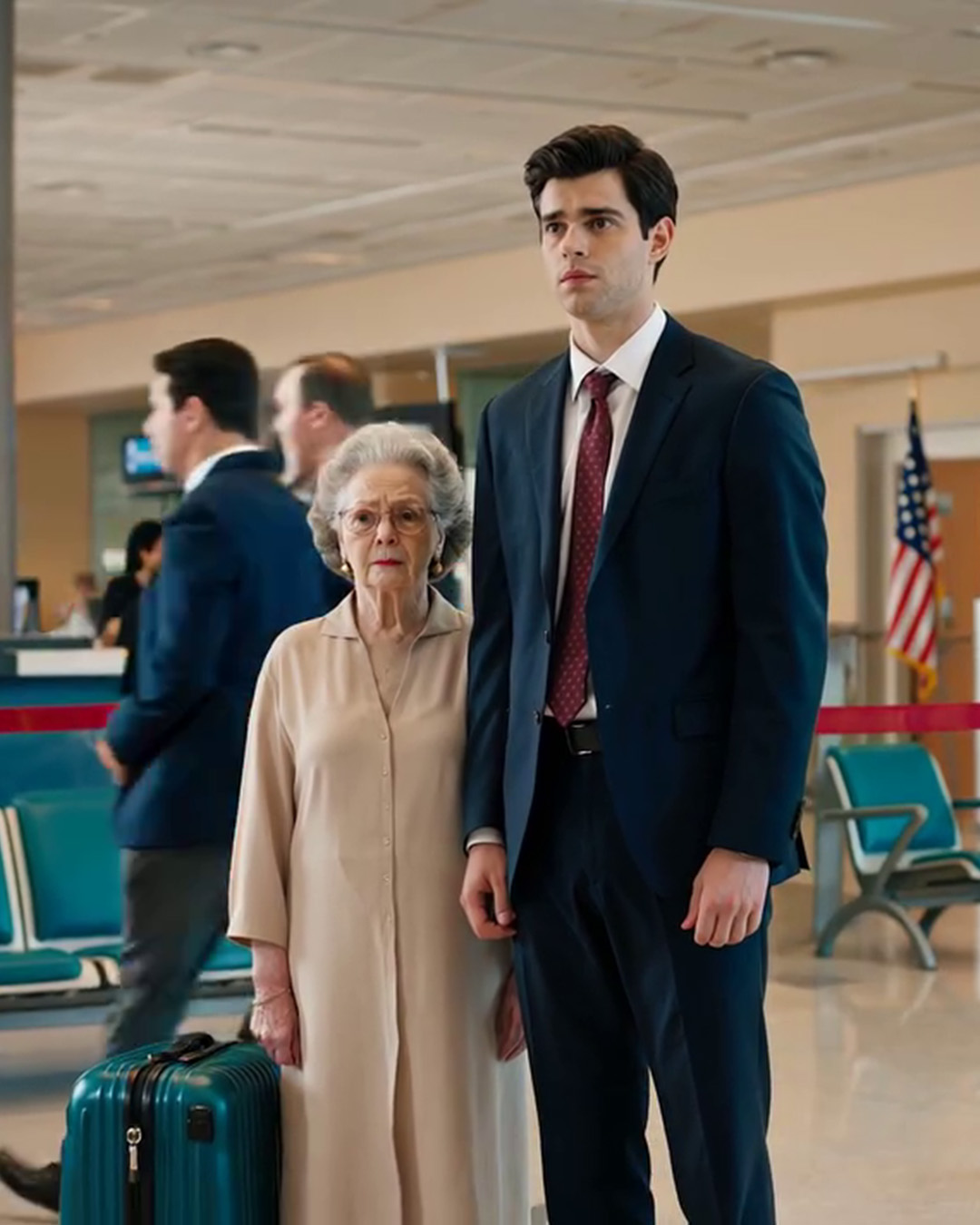
I thought about everything—from that airport, to the courtroom, to her last months.
I didn’t regret calling APS. I didn’t regret testifying. But I couldn’t help wondering if things could have ended any differently. If there had been a path where my grandmother was safe and loved and my family hadn’t completely shattered.
Then I remembered what she said.
“If only they knew how to love.”
It hit me that I hadn’t torn this family apart. They had when they chose selfishness over love, over and over again, long before a courtroom ever got involved.
I decided to stay in Tuloma for good.
This town, with its quiet streets and hospital on the hill, felt more like home than Greenville ever had. I took a residency at Tanova Healthcare Harton—the same hospital where my grandmother had once pushed carts down hallways and checked pulses under dim fluorescent lights.
Every shift I walk through those doors and see the small American flag by the entrance, I think of her.
I listen to patients. I sit with families. I remember her telling me, “Sometimes people don’t need medicine first. They need someone to really hear them.”
One afternoon, while cleaning out the house, I found a box under her bed.
Inside were letters. Dozens of them. All addressed to me.
She’d written them over the years—when I was a kid in Greenville, when I was busy with school, when I only saw her in the summers. She never mailed them; she just kept them, page after page of her handwriting.
She talked about her garden. About the weather. About the little boy she remembered running around her yard with scraped knees. She told me she thought of me every time she saw a boy my age at the grocery store. She tucked in small pieces of advice.
“Calvin, you are my light,” one letter said. “No matter how hard life gets, always do what’s right. That’s what makes you different.”
Tears blurred the ink as I read.
I hung her marigold painting in my office at the hospital.
Patients comment on it sometimes.
“That’s a cheerful picture,” they say.
I smile and tell them it belonged to someone very special.
I started writing our story down—everything from that Facebook memory at the Atlanta airport to the trial, to her final months. Not to drag my parents through the mud, not to brag about standing up to them, but to make sure my grandmother isn’t reduced to that one moment of betrayal.
She was more than the woman left at an airport.
Była pielęgniarką, która została po zakończeniu dyżuru, ponieważ samotny pacjent nie miał nikogo innego. Była babcią, która nauczyła wnuka piec ciasteczka i być odważnym. Była osobą, która nauczyła mnie, że czasami miłość oznacza podejmowanie najtrudniejszych decyzji.
Trzy lata po zakończeniu rezydentury stałam sama w swoim małym biurze w Tanova, mój certyfikat wisiał na ścianie, a obraz przedstawiający nagietek łapał popołudniowe światło.
„Babciu” – powiedziałem cicho – „zrobiłem to”.
Nikt nie odpowiedział. Ale jakoś pokój wydawał się mniej pusty.
Nigdy więcej nie odezwałem się do rodziców ani do Pauli. Nigdy nie zadzwonili ani nie napisali. Cisza między nami wyraziła wszystko, co należało powiedzieć.
Nie nienawidzę ich. Nie leżę bezsennie, planując zemstę. Po prostu… jest mi ich żal. Życia, które wybrali. Życia bez kobiety, która kochała ich najbardziej. Życia bez wnuka, który stanąłby przy nich, gdyby tylko wybrali właściwą drogę.
Patrząc wstecz, wiem, że życie jest niesprawiedliwe. Ludzie chorują. Ludzie odchodzą. Ludzie cię zdradzają. Ale nadal możemy wybrać, jak zareagujemy.
Moja babcia nauczyła mnie, że miłość to nie słowa. To to, co robisz, gdy jest ciężko. To to, żeby stać u boku kogoś, gdy wszyscy inni odchodzą. To walka o sprawiedliwość, nie dlatego, że jest łatwa, ale dlatego, że nie mógłbyś żyć ze sobą, gdybyś tego nie robił.
Straciłem ją. Ale tracąc ją, odnalazłem sens swojego życia.
Jeśli dotarłeś aż tutaj, mam nadzieję, że wyciągnąłeś z mojej opowieści jedną naukę.
Rodzina to nie tylko ludzie, którzy noszą to samo nazwisko lub siedzą przy stole podczas świąt. To ci, którzy pojawiają się, gdy jest to ważne. Ci, którzy cię chronią, nawet gdy coś ich to kosztuje.
Nie bój się stanąć w obronie tego, co słuszne. Nawet jeśli oznacza to sprzeciwienie się ludziom, o których kiedyś myślałeś, że zawsze będą po twojej stronie. Sprawiedliwość nie jest łatwa. Może boleć. Może kosztować cię relacje, których utraty nigdy nie spodziewałeś się stracić.
Ale niektóre rzeczy są warte tej ceny.
A jeśli masz w życiu kogoś, kto kocha cię tak, jak moja babcia kochała mnie – cicho, żarliwie, bezwarunkowo – pielęgnuj go. Słuchaj go. Ucz się od niego.
To oni kształtują to, kim jesteś, długo po ich śmierci.
Żyj z otwartym sercem i niezachwianą odwagą.
I pamiętaj: bez względu na to, ile razy życie cię powali, zawsze masz siłę, żeby się podnieść – dla ludzi, których kochasz i dla siebie.